The MIR quota for foreign doctors: what it is and how to get in
What the quota is, how many places the January 2027 exam offers, who qualifies and which paperwork to start now.
If you are a doctor outside Spain and want to sit the MIR, sooner or later you will run into a word that sounds like a lottery: the quota. It is not. It is a cap on places for people who do not have residence in Spain, and understanding it early can save you months of badly ordered paperwork.
Here is what it is, who qualifies, what you are asked for, which dates the current call sets and where to start.
What the quota is
The quota is a cap: the law sets the maximum number of Medicine places that can be awarded to applicants without a residence permit in Spain. Until 2022 that maximum was 4%. Royal Decree 589/2022, published in July 2022, raised it to 10% (art. 17.2). For other degrees the cap is lower: 3% in Pharmacy and 1% in Nursing.
Mind the “up to”: 10% is a ceiling, not a guaranteed share. Each call decides how many places it offers.
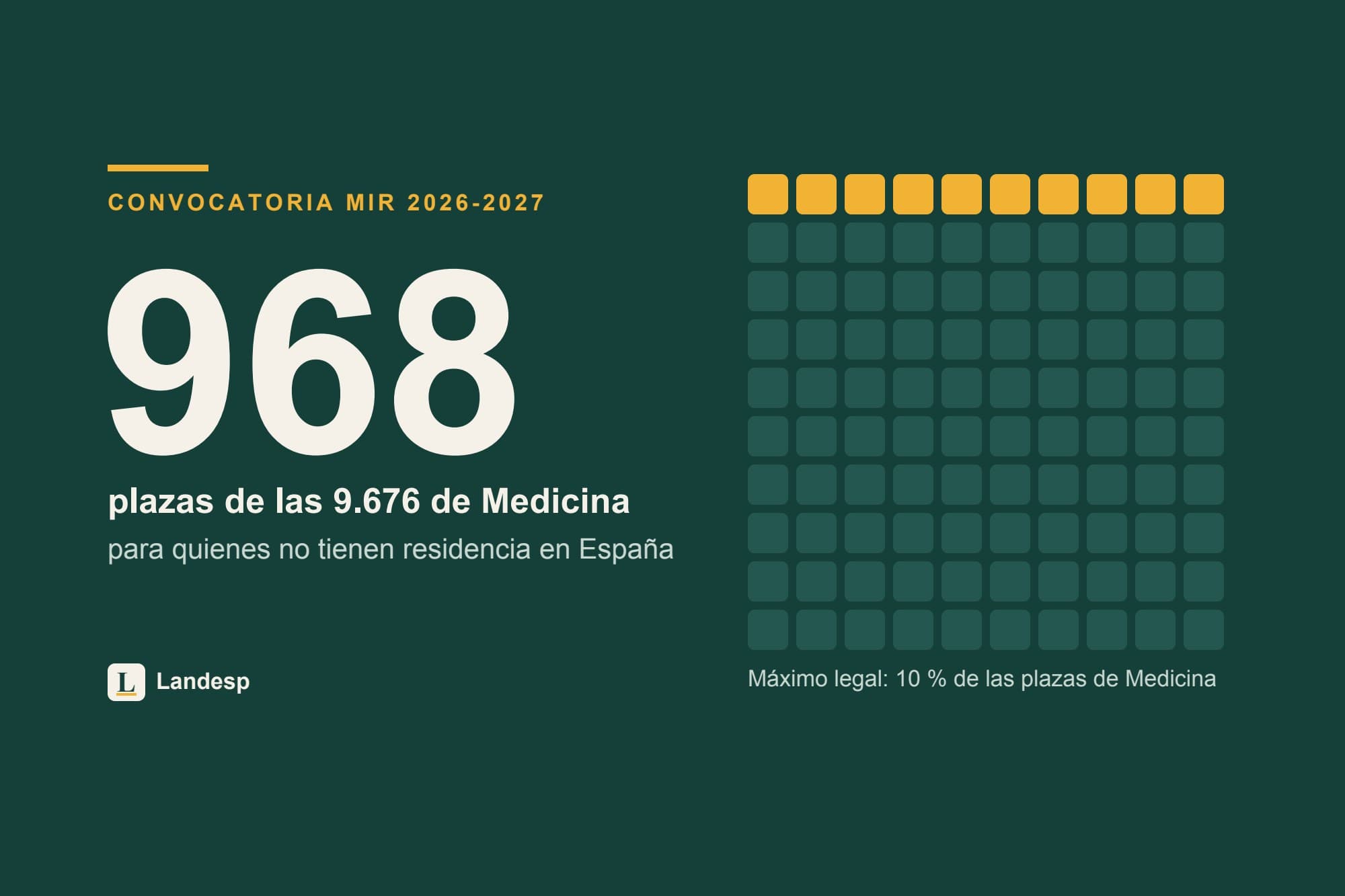
In the current call (Order SND/854/2026, published in the BOE on 10 August 2026) it is 968 of the 9,676 Medicine places. In the 2026 exam it was 928.
And every year there are more people behind it. According to Redacción Médica, recognitions of non-EU Medicine degrees went from more than 8,800 in 2024 to more than 30,000 in 2025. In the 2026 call, 4,606 foreign applicants were accepted, 1,320 of them from outside the EU.
Who qualifies for the quota and who does not
The quota is for people who do not hold a residence permit in Spain. The call adds two conditions: your country of origin must have a cooperation agreement with Spain in force, and your degree must be homologated or recognised.
- You live outside Spain, your country has an agreement with Spain and your degree is homologatedYou compete for the quota.
- You are in Spain only with a stay permit (for studies, for example)You also compete for the quota.
- You hold a residence permit, temporary or permanentYou leave the quota and compete in the general round.
- You hold the nationality of an EU country, the EEA, Switzerland or AndorraYou are not in the quota: your status is “EU regime” and you compete in the general round.
The order does not include the list of countries with an agreement. If you are unsure whether yours counts, the Ministry of Health gives the address correofse@sanidad.gob.es for information.
The difference matters: with residence you stop competing for a limited number of places. To prove it, the call asks for your passport and, if you are in Spain on a stay, your valid foreigner identity card. This is a reading of the order's rules, not legal advice: check your own case in the official text before deciding anything.
What you need before you apply
Everything is proved in the application at once, and what is not ready when the window closes does not count.
According to the order, this is what is required:
- A homologated or recognised degree. It must be granted before the application window ends. The Ministry of Science resolves homologation within six months at most (if it does not reply, it is treated as refused) and it can come out conditional: if it finds gaps, you are asked for internships, an aptitude test or courses, and you do not get the credential until you pass them. If your degree is from another EU country, it is proved through the recognition of professional qualifications.
- Spanish at level C1. If Spanish is not the official language of your country, you need an official diploma (DELE or equivalent). People who studied the degree in Spanish at a Spanish university or one in a Spanish-speaking country are exempt, and so are those who have already done two years of specialised healthcare training in Spain.
- An academic certificate and the equivalence of your average grade. Your transcript average adds 10 of the 100 points. With studies abroad you need the Ministry of Science's declaration of equivalence and your university's certificate. Without them, you are given an average of 5.00.
- The exam fee. For Medicine it is 31.10 euros.
 Keep readingBLS jurisdiction in the US: State ID, Real ID and proof of residence
Dates: what has passed and what is coming
For the exam on 23 January 2027, the application window is already closed.
According to the order, these are the two dates:
- Application: from 1 to 14 September 2026, both included.
- Exam: 23 January 2027, at 14:00 (13:00 in the Canary Islands): 200 questions plus 10 reserve ones, lasting four and a half hours. It is in person, in one of the 26 places in Spain listed in the order.
If you missed it, the call that matters to you is the next one. It has not been published yet. The previous one had its application window from 1 to 12 September 2025 and its exam on 24 January 2026. If the calendar repeats (order in August, applications in September, exam in January), the next application window would be in September 2027. That is an estimate, not an official date.
In practice, you have a year ahead of you. Degree homologation is handled by the Ministry of Science, which has up to six months to resolve (longer if you are asked for complementary training), and the call requires it to be granted before the application closes. Start there.
What to do, step by step
Order matters: what takes longest goes first.
Homologate your degree and request your grade equivalence
Both go to the Ministry of Science, with legalised original documents: degree, transcript and syllabus. Without a homologated or recognised degree you cannot sit the exam, and without the grade equivalence you lose points. If the homologation comes out conditional, the credential does not arrive until you complete the training you are asked for.
Prove your Spanish
If your language is not Spanish, book the diploma exam in advance: C1 is an admission requirement, not a bonus.
Decide where you will prepare
If you will prepare in Spain, the Immigration Regulation provides a long-stay visa for courses preparing for the specialised healthcare training exams. It is requested at the Spanish consulate in your country at least two months before the course starts, and requires, among other things, a homologated or recognised degree, admission to the course with the fees paid, a passport valid for one year, funds (100% of the IPREM per month), health insurance, a medical certificate and, if you are an adult and the stay exceeds six months, criminal record certificates from the countries where you have lived in the last five years. Each consulate publishes its exact list. The exam is in person in Spain, so, if you do not come on that visa, depending on your nationality you may need a short-stay visa to come and sit it.
If your stay lasts longer than six months, you have one month after entering to apply for the TIE at the police station.
Register at your address and sort out housing
You will need a home to live in and, with it, an address. As soon as you have one, register: the law requires you to register in the padrón of the municipality where you habitually live (Law 7/1985, art. 15).
If you are awarded a place, prepare your permit before taking up the post
People from outside the EU need, before taking up the post, a permit that lets them live in Spain and do specialised healthcare training. In the Immigration Regulation it is a long-stay authorisation, and you do not need to request a work permit as well. You will also be asked for a fit medical exam, the certificate of sexual offences and professional registration where the law requires it to practise.
Mark September
That is the month the application window usually opens. Check as soon as the order is published.
Common mistakes
The four most common slip-ups:
- Thinking that homologation means having a place. Homologation lets you sit the exam. Your score decides the place.
- Thinking the quota is a place reserved for you. It is a cap: the call does not guarantee that all 968 are filled, or that you fill one.
- Leaving homologation for last. It is the slowest step and it must be granted before the application closes, not after.
- Assuming nursing, pharmacy or psychology work the same way. In the same order, the quota is 23 places in Nursing and 4 in Pharmacy. Psychology, Chemistry, Biology and Physics have no quota.
Sources: Order SND/854/2026 (BOE, 10 August 2026) and Order SND/928/2025 (BOE, 21 August 2025); Royal Decree 589/2022; Royal Decree 889/2022; Royal Decree 1155/2024 (Immigration Regulation); Redacción Médica, 20 July 2022 and 22 April 2026. Data as of October 2026. This article is informational and does not replace legal advice.