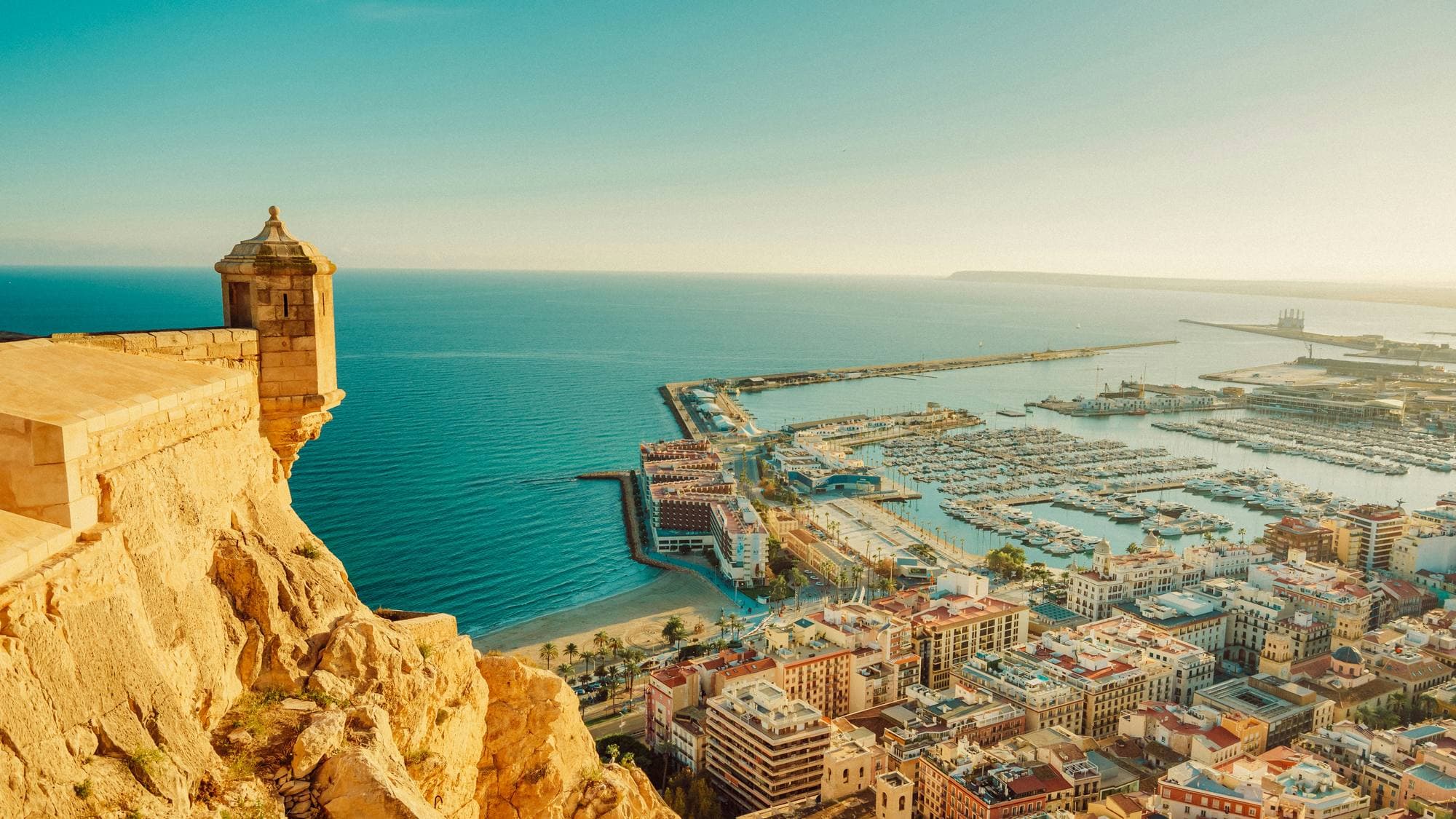
Living in Alicante in 2026
Everything you need to decide, plan and move to Alicante: real living costs, neighbourhoods, paperwork and life on the Mediterranean.
Alicante in Numbers
Is Alicante right for you?
Alicante is a mid-sized city — around 350,000 people — with a beach inside the city, mild winters and costs clearly below Madrid, Barcelona or Valencia. Its size is its character: almost everything is close by, but the job market is narrower than in a large capital.
Pros
- Living costs 20% to 35% below Madrid and Barcelona, and still below Valencia.
- A city beach you can walk to (Postiguet) and a long beach 15 minutes away by tram (San Juan).
- Mild, very dry winters: the temperature rarely drops below 10 °C and it seldom rains.
- An international airport 11 km away with direct flights across Europe, which matters if you work remotely.
- A flat, walkable city, with the tram linking the centre to the beaches and the towns to the north.
Cons
- A job market concentrated in tourism, services, footwear and retail; fewer corporate and tech openings than in the big capitals.
- Rents have risen sharply in recent years, around 9% year on year, pushed by international demand.
- Strong seasonality: in summer the city and its beaches fill up, and holiday lets shrink the long-term supply.
- Structural drought and expensive water across the province.
The cost of living in Alicante
Estimated monthly range for a couple in a 70–90 m² flat. Sharing a flat, the reference is around €550–€800/month; living alone, it rises to €1,000–€1,400/month.
Monthly Expense & Income Benchmark Calculator · Alicante
Purely orientative calculation based on average market figures. Every individual or family adapts their priorities, and moving with different budgets is entirely feasible through housing and spending choices.
Estimated Breakdown
Centro / EnsancheRent is recommended not to exceed 35% of net household income.
Market benchmark estimate: 1,874 € / month for this profile in Centro / Ensanche.
This calculator provides indicative estimates and does not represent a financial guarantee. Actual expenses depend on lease terms, utility consumption, and personal habits. Moving with lower budgets remains fully achievable through room sharing or suburban housing.
This calculator provides indicative estimates and does not represent a financial guarantee. Actual expenses depend on lease terms, utility consumption, and personal habits. Moving with lower budgets remains fully achievable through room sharing or suburban housing.
Average expense reference table
| Item / Category | Amount / month |
|---|---|
| Estimated rent · 70–90 m² | €950–€1,350 |
| Groceries & household · couple | €350–€500 |
| Transport · two people | €40–€70 |
| Utilities, internet & mobile | €150–€230 |
| Leisure & eating out | €250–€450 |
| Private health insurance · couple | €110–€220 |
Landesp estimate for the city of Alicante in 2026, with rent averaging around €13/m² and up to €15/m² in Playa de San Juan and Cabo de las Huertas. Real costs vary by neighbourhood and lifestyle.
Where to live — Alicante neighbourhoods
Centro & Ensanche Diputación
City life · everything on footThe administrative and commercial heart, between the Explanada and the Rambla. Grand buildings, everything within walking distance and some of the highest prices in the city.
Old Town (Santa Cruz)
Charm · night-time noiseNarrow streets climbing Mount Benacantil, whitewashed houses and plenty of life. Beautiful by day and loud at night: visit the flat on a weekend before you sign.
Benalúa & Florida
Families · best valueResidential and quiet, next to the station and well connected. One of the best balances of price, services and proximity to the centre.
Playa de San Juan & Albufereta
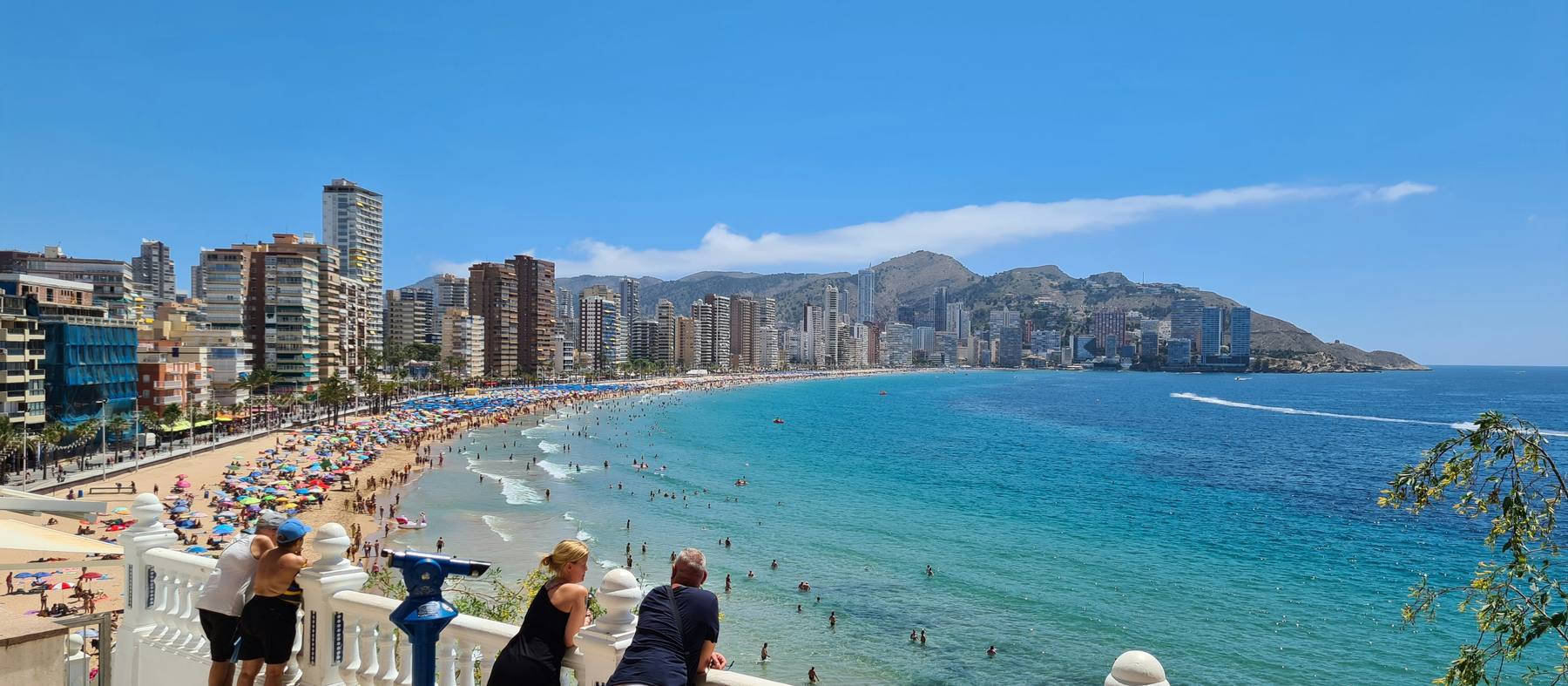
Beach · international residentsModern blocks by the long beach, around 20 minutes from the centre by tram. Suburban feel, a car is advisable and seasonality is high.
Vistahermosa & the PAU districts
Families · new buildNewer areas to the north, with houses, gated developments with pools and international schools. You will need a car.
Housing and rent in Alicante
The rental process step by step
Searches happen on Idealista, Fotocasa and above all through local agencies, which hold much of the long-term supply. You will be asked for proof of income (payslips or a contract), the legal one-month deposit and, often, an extra guarantee if your contract is foreign.
Types of rental
- Primary residence (long term): Five-year contracts with private landlords, seven with companies. It allows the empadronamiento, which is compulsory.
- Seasonal rental: One to eleven months with a justified reason. Very common in Alicante because of tourism: make sure it is not offered as a substitute for a primary-residence contract.
- Room in a shared flat: Between €300 and €480/month depending on the area.
- Coliving and furnished rentals: From €600/month with utilities included, concentrated in the centre and Playa de San Juan.
Beware of high season
Between June and September much of the rental stock shifts to holiday lets and long-term prices tighten. If you can choose, search between October and March: there is more supply and more room to negotiate.
How to avoid scams
Never transfer money before visiting the property or verifying ownership at the land registry, and check that the contract expressly allows the empadronamiento. On the coast the landlord often lives abroad: always ask for ID and a land registry extract.
Paperwork for living in Alicante
What is the same across Spain, summarised — plus the local steps to settle in Alicante.
National: entry routes and visas
Visas: Primary Entry Routes
- Tourist Stay (up to 90 days): No right to work. Passport holders from US, UK, Canada, Australia, and parts of LATAM enter visa-free for tourism.
- Employment Visa (Cuenta Ajena): Requires a job offer from an authorized Spanish employer.
- Digital Nomad Visa: For remote workers of foreign companies; requires proof of minimum income.
- Student Visa: For accredited official educational programs.
- Non-Lucrative Visa (NLV): For individuals with independent financial means who do not intend to work in Spain.
- Family Reunification: For relatives of legal residents.
This section is informative and does not constitute legal counsel. Always check official Ministry channels or consult a certified immigration lawyer.
Essential first steps on arrival in Alicante
Once in Alicante, this order avoids getting stuck:
- 1. Town hall registration (empadronamiento): At Alicante City Council, by appointment at the Oficinas de Atención Ciudadana or online with a digital certificate. It unlocks healthcare and school enrolment.
- 2. Health card (SIP): At your assigned health centre, with the padrón certificate and your Social Security registration. Alicante belongs to the Valencian health service, like Valencia.
- 3. Spanish bank account: To pay rent and utilities by direct debit and to get paid.
- 4. Fingerprints and TIE or EU registration certificate: Appointment at the Alicante Immigration Office or a National Police station.
- 5. Transport and connectivity: The Tarjeta Movilidad for TAM and TRAM, plus mobile and fibre contracts.
Healthcare in Alicante
Public healthcare (Valencian health service · SIP)
Alicante runs on the Valencian SIP card, which assigns you a health centre and a family doctor. The city's reference hospitals are Hospital General Universitario Doctor Balmis and Hospital Universitario de Sant Joan d'Alacant.
Emergency numbers
- 112: General emergencies: police, fire and ambulance.
- 061: Medical emergencies.
- 091 / 092: National Police and Local Police.

Getting around Alicante
TAM city and metropolitan buses, the TRAM d'Alacant to the beaches and the north of the province, and Cercanías and high-speed trains at Alicante Terminal.
TAM and TRAM: two networks, one card
City buses are run by TAM and the tram by TRAM d'Alacant (FGV). The Tarjeta Movilidad works on both; tram lines 1 and 2 link the centre with Playa de San Juan, Sant Joan d'Alacant, El Campello and, further north, Benidorm and Dénia.
| Ticket | What it covers | Indicative price |
|---|---|---|
| TRAM · single ticket (1 zone) | One trip inside the urban zone | €1.45 |
| TRAM · Bono 10 (1 zone) | Ten trips | €8.00 |
| TRAM · Mobilitat monthly (1 zone) | Unlimited travel for 30 days | €22.80 |
| TAM · 30-day pass | Unlimited city buses for 30 days | €24.00 discounted (€40.00 undiscounted) |
Airport and trains
Alicante-Elche Miguel Hernández airport (ALC) is 11 km from the centre, linked by bus line C-6 in about 25 minutes. From Alicante Terminal station, the high-speed train reaches Madrid in about 2 h 20 min.
Do you need a car?
In the centre, the Ensanche and Benalúa, no: you walk or take the tram. In Playa de San Juan, Vistahermosa and the PAU districts, yes — especially with children or if you work outside the city.
Working in Alicante
The job market in Alicante
The province runs on tourism and services, with footwear and leather goods in the Vinalopó valley (Elche, Elda, Villena), toys in Ibi, and a growing tech cluster around the University of Alicante Science Park and the EUIPO, the European Union's intellectual property office, headquartered in the city. Alicante is also one of Spain's top destinations for foreign remote workers.
Key employment differences
- Employee: An employment contract with a Spanish company; 30 days of annual leave.
- Self-employed (autónomo): Contributions based on real income (RETA) plus VAT and income tax filings.
- Digital nomad: International remote workers with a visa and a special tax regime.
Self-Employed Contributions (Autónomo 2026)
Under the contribution system based on net income, monthly self-employed social security contributions are calculated across 15 brackets. Reference rates:
| Monthly Net Earnings | Approx. Monthly Contribution |
|---|---|
| Up to €670 | €200 |
| €671 – €900 | €220 |
| €901 – €1,166.70 | €260 |
| Higher Brackets | Up to €590/mo for earnings above €6,000/mo |
First-time autónomos in Spain can access a flat rate (Tarifa Plana) of €80/month for the first 12 months regardless of billing amount.
Tax Considerations
If you spend more than 183 days a year in Spain, you are considered a tax resident and subject to progressive personal income tax (IRPF 19% to 47%) on worldwide income.
Immigration status and tax residence are legally distinct. Always consult a specialized tax advisor for cross-border income.
Banking and utilities in Alicante
Bank account
Banks with a wide provincial network: CaixaBank, Sabadell, BBVA and Santander; neobanks: N26, Revolut or Wise. You will need a passport, your NIE and proof of the source of funds. In Alicante many branches serve customers in English, given the number of foreign residents.
Home utilities and internet
- Water: Aguas Municipalizadas de Alicante (Aigües d'Alacant) supplies the city.
- Electricity and gas: Free or regulated market: Iberdrola, Endesa, Naturgy and independent retailers.
- Internet: Symmetric fibre across almost the whole city with Digi, Movistar, Orange, O2 or Vodafone: €30–€50/month.
Daily life in Alicante
Hours and customs
- Mid-morning almuerzo: Between 9:30 and 11:30, the sandwich break is a firm habit across the Valencian Community.
- Lunch: 2:00–3:30 pm.
- Dinner: 9:00–10:30 pm.
- Hogueras de San Juan: From 20 to 24 June the city stops: it is the main festival, listed as being of International Tourist Interest.
Language
Spanish and Valencian are both official. In the city of Alicante everyday use of Valencian is noticeably lower than in Valencia or inland towns, but it appears in public administration, signage and schools. Because of the size of the foreign community, many coastal businesses also serve customers in English.
Supermarkets and markets
- Mercado Central: A modernist building by the Rambla, with fresh fish and produce daily.
- Supermarkets: Mercadona, Consum, Masymas (an Alicante chain), Lidl, Carrefour and Aldi.
Mobile and internet
- Arrival lines (prepaid / eSIM): €5–€15/month, activated immediately with a passport.
- Home fibre + mobile: €30–€55/month with Digi, O2, Pepephone, Lowi or Movistar.
- Requirements: Direct-debit contracts usually require a Spanish IBAN.
Common mistakes when moving to Alicante
- 1
Signing a seasonal rental thinking it is a primary-residence contract, and ending up unable to register at the town hall.
- 2
House hunting in July or August, when long-term supply is at its lowest and prices at their highest.
- 3
Choosing Playa de San Juan without allowing for the car, or the 20-minute tram ride, that every errand in the centre will take.
- 4
Underestimating waiting times for padrón and fingerprint appointments.
- 5
Confusing the NIE with a residence permit: the number does not grant you the right to live here.
Checklist for moving to Alicante
Before you travel
- Visa or residence permit granted at the consulate (if applicable).
- Legal documents translated and apostilled (criminal record, birth or marriage certificates).
- Temporary accommodation booked for the first 2 to 4 weeks, outside high season if possible.
- Available funds and active international cards.
First 30 days
- Long-term rental contract signed, with the empadronamiento authorised in writing.
- Padrón appointment and certificate at Alicante City Council.
- Spanish bank account with IBAN opened.
- Registration at your health centre and SIP card requested.
- Fingerprint appointment for the TIE or EU registration certificate.
- Tarjeta Movilidad for TAM and TRAM.
How Landesp helps you in Alicante
End-to-end support for individuals, families and professionals moving to Alicante:
- Full advice and processing for visas and residence permits.
- Rental search and legal review of contracts, with particular attention to seasonal leases.
- Empadronamiento, SIP card and immigration appointments handled for you.
- School guidance for families and bank account opening.
Frequently asked questions about living in Alicante
How much money do you need to live in Alicante?
Roughly €700–€1,000/month sharing a flat, or €1,200–€1,800/month for a couple in their own place.
Is Alicante cheaper than Valencia?
Yes, on rent: Alicante averages around €13/m² against roughly €17/m² in Valencia. The gap narrows in Playa de San Juan.
Do you need to speak Valencian?
Not for daily life or work. Spanish dominates in the city of Alicante, although Valencian is co-official and taught in schools.
Do I need a car?
Not in the centre. In Playa de San Juan, Vistahermosa or the PAU districts, it is advisable.
What happens in summer?
The city's population multiplies, the beaches fill up and long-term rentals become scarce. If you move then, book temporary accommodation well ahead.
Planning your move to Alicante?
We design a tailored plan for your arrival in Alicante, with legal, housing and logistical support from start to finish.