1099 freelancers and the digital nomad visa: invoices and the 20% rule
Comprehensive guide for independent 1099 contractors: proving client history, drafting commercial contracts, and complying with the 20% domestic revenue cap.

If you are a self-employed professional, 1099 contractor, or agency owner, Spain’s Digital Nomad Visa is remarkably accessible—provided your paperwork aligns with Spanish administrative standards. Unlike salaried employees who rely on payroll, freelancers must substantiate their business relationships through specific commercial contracts, historical invoices, and strict compliance with the statutory 20% domestic income limit.
The 3-Month Client History Requirement
Article 74 bis of Law 14/2013 mandates that independent remote workers must prove an established commercial relationship with foreign corporate clients lasting for at least three continuous months prior to filing the application.
This is verified through two mandatory documents: an active Master Services Agreement (or commercial contract) clearly detailing remote delivery of services, and corresponding commercial invoices accompanied by full bank statements showing actual settlement of payments. Ad-hoc gig platforms or casual, uncontracted assignments are frequently rejected by UGE adjudicators.
The Statutory 20% Spanish Income Cap
A critical condition unique to self-employed digital nomads is the revenue origin threshold. Under Law 14/2013, independent professionals residing in Spain under this permit may work for Spanish companies, provided that professional income derived from Spanish entities does not exceed 20% of their total aggregate business revenue.
The primary economic justification of your permit is the influx of foreign capital into Spain. If your Spanish invoicing crosses the 20% threshold during any given tax year, the immigration authorities can revoke the permit upon renewal, requiring you to modify your status to standard domestic self-employment (autorización de residencia y trabajo por cuenta propia).
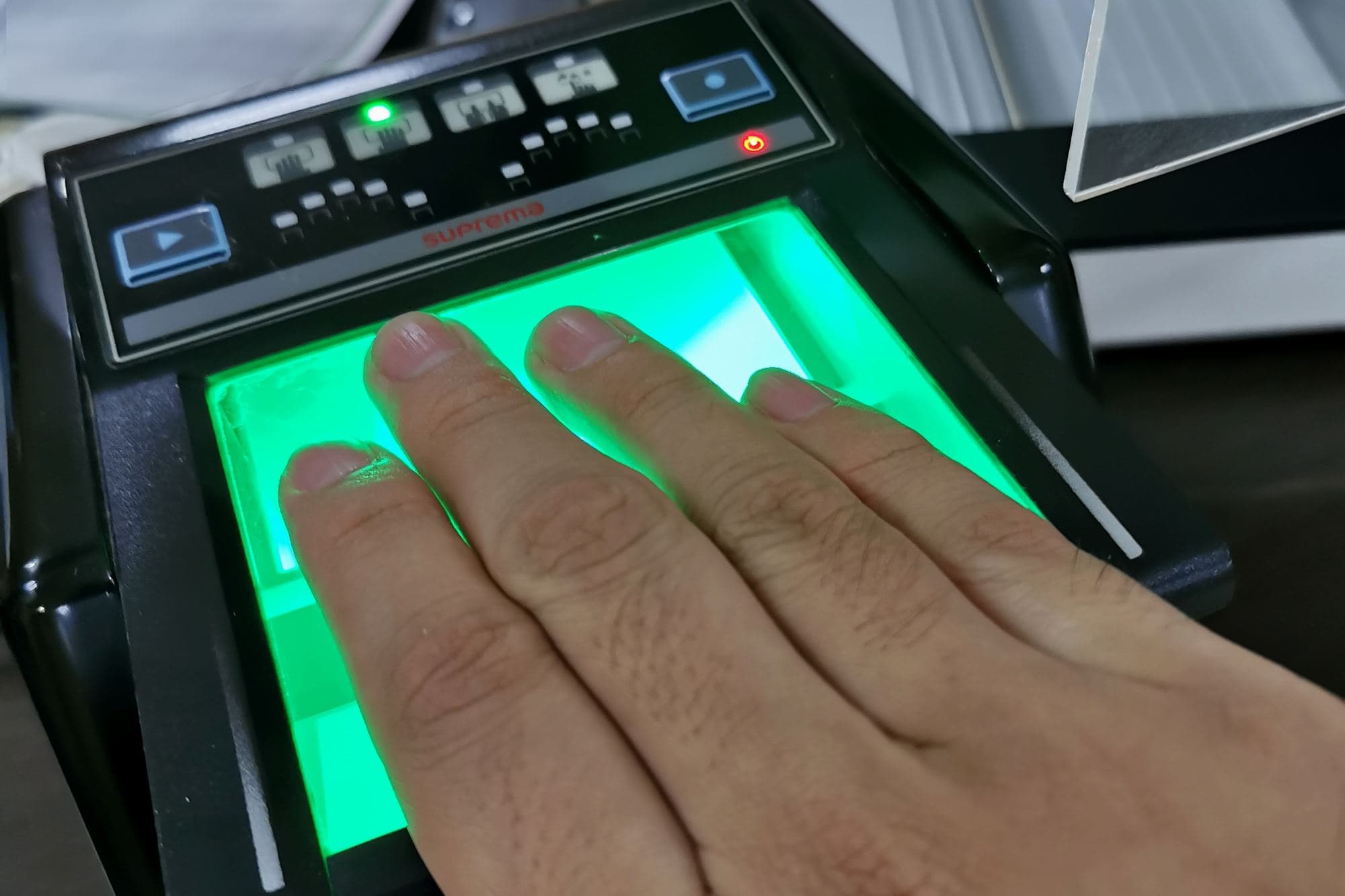 Keep readingThe TIE fingerprint appointment at the National Police, step by step
Enrolling in RETA: Social Security and the Flat Rate (Tarifa Plana)
Upon approval of your 3-year UGE residence permit, you have exactly one month from arrival or approval to register with the Spanish Tax Agency (Agencia Tributaria - Modelo 036 or 037) and enroll in the Special Regime for Self-Employed Workers (RETA) with the Social Security Administration (TGSS).
New autónomos in Spain are entitled to the subsidized 'Tarifa Plana' social security contribution—a reduced flat fee of approximately €80 to €85 per month during their first 12 months of activity, irrespective of their gross monthly earnings.
1099 Freelancer Compliance Framework: Domestic vs. Foreign Invoicing
| Metric / Requirement | Allowed Ratio | Proof Required by UGE | Tax & Social Security Treatment |
|---|---|---|---|
| Foreign Client Billing (US, UK, Latam) | Min. 80% of total revenue | Invoices, signed contracts, bank statements | Taxed under IRPF or Beckham Law |
| Spanish Client Billing (Local entities) | Max. 20% of total revenue | Local invoices with Spanish NIF and VAT/IVA | Requires registration as Spanish Autónomo |
| Client Relationship History | Minimum 3 months active billing | Master services agreement + bank deposits | Shows established commercial relationship |
| Professional Accreditation | Mandatory bachelor's or 3 years exp. | University degree with apostille or portfolio | Validates professional standing |
Key Practical Tips
What the team recommends before you file anything:
- Contracts must explicitly include a clause confirming that services are delivered entirely via computer telecommunications and do not require physical presence in your clients' jurisdictions.
- Keep invoices systematically organized in PDF format showing client legal tax IDs, invoice dates, service descriptions, and payment confirmation stamps.
Required Documentation Checklist
- Formal commercial service agreements with foreign clients active for at least 3 months.
- Last 3 months of consecutive commercial invoices corresponding to contracts.
- Bank statements demonstrating full receipt of funds corresponding to submitted invoices.
- Written affidavit certifying that income from Spanish companies does not exceed 20% of total revenue.
- University degree in a related field or documented proof of 3 years of professional experience.
Sources: Boletín Oficial del Estado (BOE) - Ley 14/2013 de apoyo a los emprendedores (Art. 74 bis); Criterios de Aplicación Práctica UGE-CE sobre trabajadores por cuenta propia; Ley 20/2007 del Estatuto del trabajo autónomo en España.