Understanding Apostille Services: A Complete Guide for Americans Moving to Spain
Which documents need an apostille, State vs. Federal FBI checks, translations, and how to avoid costly consular delays.
Apostille services help prepare documents for international use by coordinating the certification of official signatures and seals. For Americans moving to Spain, understanding which documents need an apostille—and which authority issues it—can prevent avoidable paperwork problems. This guide explains the process, with particular attention to Spain’s digital nomad visa requirements and the role of the Spanish consulate.
What is an apostille, and what does it actually certify?
An apostille is a certificate that authenticates the origin of a public document for use in another country where the Hague Apostille Convention applies. It confirms the official signature, the signer’s capacity, and, where appropriate, the seal or stamp. It does not confirm that the document’s contents are accurate or that a visa application will be approved.
Think of it as verification of the official behind the document, rather than approval of everything written on it. The convention replaces a longer legalization process with certification by a designated authority in the document’s place of origin.
- NotarizationA notary performs a legally authorized act, such as witnessing a signature. Not every document needs this step, and federal records should never be notarized.
- ApostilleA designated government authority authenticates the relevant official signature for use under the 1961 Hague Convention.
- TranslationThe document’s language is converted into Spanish by a certified sworn translator (traductor jurado); this does not replace authentication.
For covered U.S. documents going to Spain, a valid apostille generally eliminates further Spanish consular legalization. Translation and visa-document requirements remain separate.
Do you need a visa for Spain as a U.S. citizen?
U.S. citizens can generally visit Spain and the wider Schengen Area without a visa for up to 90 days in any 180-day period for permitted short-stay purposes. That exemption is not a blanket authorization to relocate or work remotely. If you are moving to Spain from the USA, establish the appropriate immigration route before ordering apostilles.
The right Spain visa for U.S. citizens depends on the activity and intended stay. Spain’s international telework route, often called the digital nomad visa, concerns qualifying remote work for businesses outside Spain. Eligible people legally present in Spain may also have an in-country residence application option, distinct from applying for a visa abroad.
Keep passport rules separate from document authentication. If you are checking Spain passport requirements for a short visit, the Spanish authorities specify validity extending at least three months beyond intended departure from the Schengen Area. For a national visa, use that visa category’s passport instructions instead.
 Keep readingMoving to Spain from the UK after Brexit: the full guide
Which documents need apostilles for Spain’s digital nomad visa?
Foreign public documents required for Spain’s digital nomad visa generally need an apostille or applicable legalization, unless an exemption applies. However, not every item in the application needs an apostille: the correct treatment depends on the document, its issuing country, and the receiving authority’s instructions. Start with the checklist for your application route.
Background checks and family records
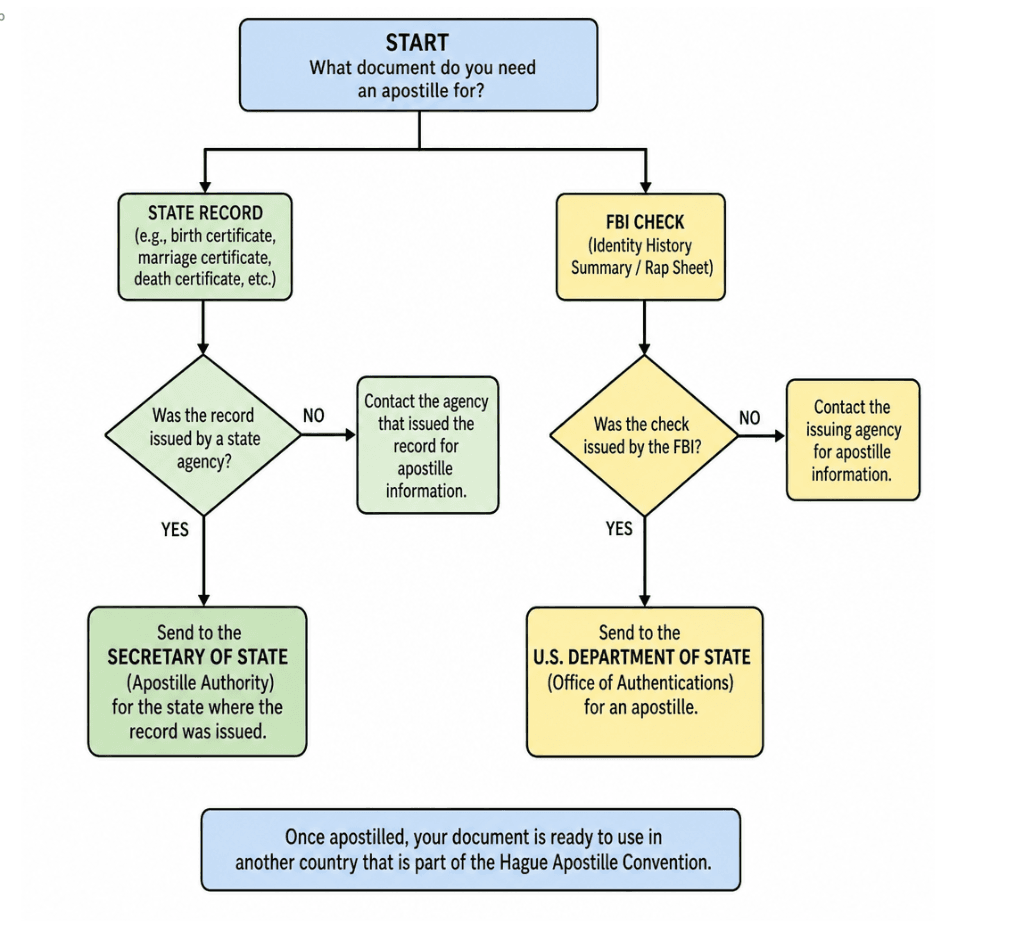
For U.S. applicants, the FBI background check is a key authentication task. Consular telework guidance requires a fingerprint-based FBI certificate with a federal apostille and an official Spanish translation. It does not accept a local or state police check as a substitute.
Family members applying as dependents must also authenticate relevant civil registry records. When U.S. vital records are needed (marriage, birth certificates), obtain certified state copies and apostille them through the state of issuance before translation.
Qualifications and commercial records
Spain’s telework pathway assesses professional qualifications or relevant experience. When submitting U.S. academic degrees or commercial documents, verify whether the reviewing body expects notarization, an apostille, or a sworn translation.
Private company documents—such as employment contracts or employer certificates—must typically be notarized by an authorized U.S. notary before the relevant Secretary of State can attach an apostille.
Apostille Routing Flowchart: State Records vs. FBI Check
Five practical steps for authenticating U.S. documents
- 1. Identify the origin and authority for each documentDetermine whether each document is federal (FBI rap sheet) or state-issued (birth, marriage certificates, diplomas, notarized agreements).
- 2. Obtain official certified copiesWork only with certified records from the issuing registrar, clerk, or federal agency. Standard photocopies cannot be apostilled directly.
- 3. Check notarization requirements carefullyNotarize only where appropriate. The U.S. Department of State specifically instructs applicants not to notarize original federal documents.
- 4. Request the correct apostille from the competent officeState records go to the Secretary of State where issued. Federal records go to the U.S. Department of State Office of Authentications with Form DS-4194.
- 5. Arrange official Spanish sworn translationsObtain certified translations from a recognized sworn translator (traductor jurado). Criminal record certificates must typically be issued within 6 months of submission.
Coordinate consular questions and timing early
The Spanish consulate assesses the visa application; it does not issue U.S. apostilles. If you search using “consul España,” make sure you reach the official consular office responsible for your jurisdiction and visa category. For covered documents already apostilled by the issuing country, additional consular legalization is not required.
Timing requires more than counting apostille processing days. Allow for record issuance, shipping, authentication, translation, appointment availability, and potential corrections. Document freshness matters: criminal-record certificates cannot have been issued more than six months before submission.
Choose apostille services for a clearly defined job
You can submit directly to the competent authority; hiring a private service is optional. If you use one, request an itemized scope covering document review, government submission, shipping, and translation coordination. Only designated government authorities issue apostilles, so private providers facilitate logistics rather than certifying documents themselves.
The strongest approach is straightforward: confirm your immigration route, obtain acceptable records, authenticate each through the correct authority, and follow the receiving office’s translation instructions. Apostille services can help with logistics, but a carefully checked application remains your best preparation.